How do I know my child is challenged?

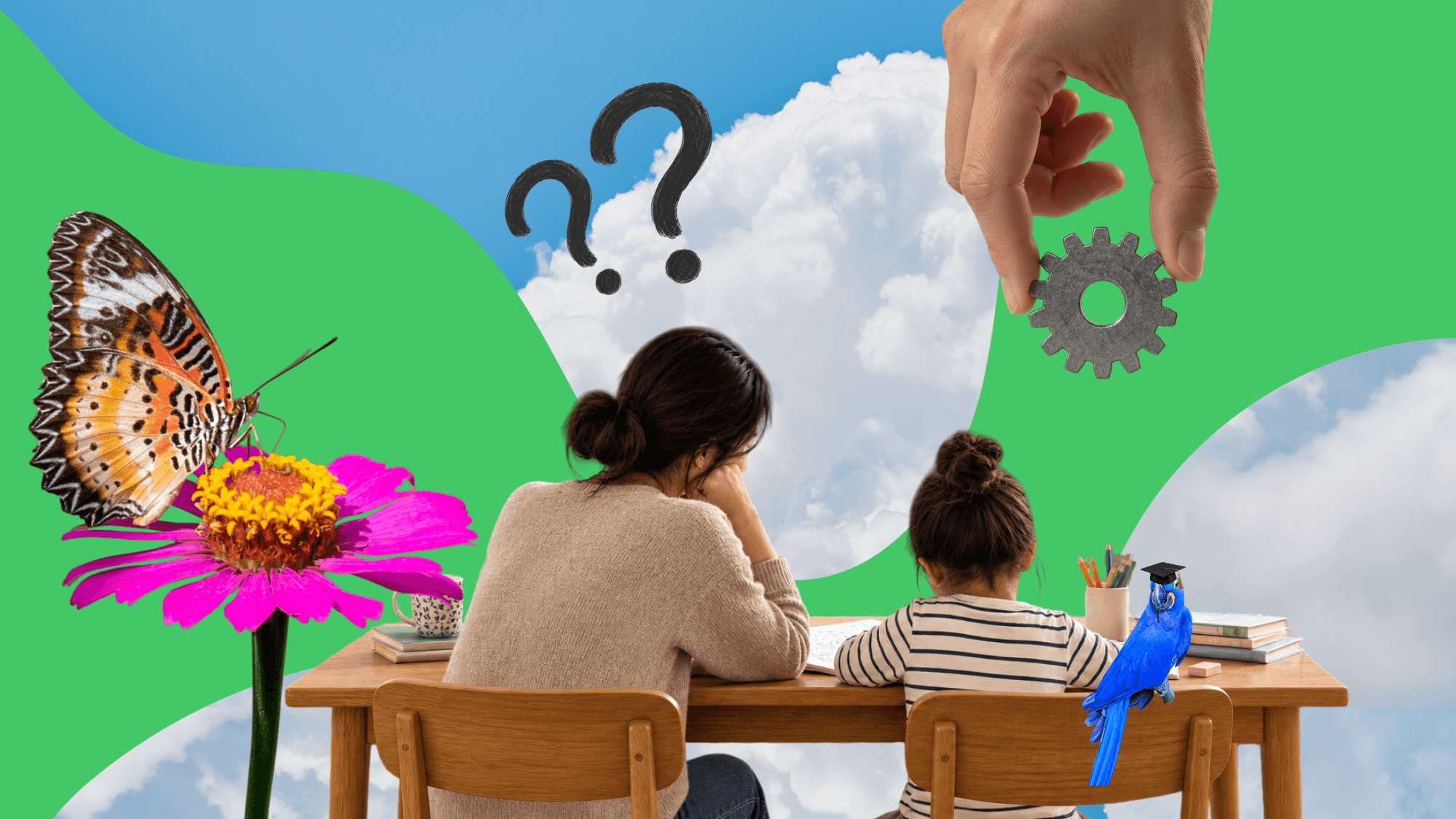

Short answer: you probably don't. (8 min read: a quick guide to why and what to do).
"How was school?" "Fine." "Was it hard?" "No."
You sit at the kitchen table holding a fork and a two-word answer, trying to figure out whether "no" means your child spent another day on things they already knew or if the work was too hard for effort to register.
I run a global school for children aged 4 to 15. Of all the questions parents raise, this one carries the most quiet worry. It is my favorite because it comes from a parent who knows school is more than daycare with a curriculum.
The uncomfortable truth is you probably cannot tell. Neither can the report card, the teacher, or your child. This is not a failure of your attention, their professionalism, or your child's reflection. It is a measurement problem that can be solved.
The 2024 NAEP results for twelfth graders show average scores in math and reading at their lowest ever. 45% of high school seniors perform below Basic in math and 32% in reading, the largest shares recorded in either subject. I see this as a system that stopped advancing its strongest students while losing its weakest, or one that has not updated how and what it measures.
Under-challenge is not a niche problem for the child who finishes early. It is closer to the median experience and compounds. A meta-analysis published this year pooled 125 longitudinal studies and 544 effect sizes. It found engagement declining across adolescence on every dimension measured—behavioral, emotional, cognitive, academic—with the steepest drop in early adolescence and around school transitions. The authors see this as a mismatch between what adolescents need and the current shape of old school.
Key takeaways
- Grades and report cards rarely show whether your child is challenged enough.
- Four blind spots hide it: grade fog, the ease illusion, borrowed judgment, and the vanishing signal.
- Under-challenge is common, not rare, and it compounds the longer it's missed.
- Swap "was it hard?" for "what did you get wrong today?" to get real evidence.
There are four ways you would expect to learn about the level of challenge your child is encountering
Door one: the school will tell me
→ Grade fog is the belief that a grade reports mastery when it actually reflects a mix of mastery, punctuality, neatness, and behavior in class.
Last October, Learning Heroes published ten years of research with families. 88% of parents say their child is at or above grade level in reading and math. National benchmark data puts the number closer to 30% for eighth graders.
Hold those side by side. Nearly nine in ten of us believe our kids are doing well, while roughly three in ten actually are. This gap has persisted for years across income and education levels, suggesting the reporting system was never meant to answer the mastery question.
Researchers at Trier measured how far the fog reaches. They tested 2,346 primary school children and asked their parents to judge their cognitive ability. The children's measured ability explained 34% of the variance in parents' beliefs. Two-thirds of that belief came from school. Parents followed reported academic achievement more than actual ability. We read the report card and infer the mind.
One more finding from that paper worried me. Parents judged their sons more accurately than their daughters, and their firstborn children more accurately than their last-born children. Nobody in that sample intended this. I would not assume you or I are exempt. Punctuality, neatness, and pleasantness are skills worth measuring and teaching. None tells you where the edges of your child's numeracy skill set sit.
This is why the ability to collect and analyze real-time evidence of learning, mapped to their learning goals, is core to the product bina is building.
Door two: my child will tell me
→ Ease illusion mistakes the feeling of effort for failure and the feeling of fluency for learning, when the relationship is the opposite.
Harvard physicists ran the cleanest version of this experiment. Identical content, identical handouts, students randomly assigned, one group taught through active instruction and one through a genuinely good lecture. The active group learned more, measured on a test. They also felt like they had learned less.
Read that twice, because it means the sentence "it was boring, and I think I didn't get it" can come from the lesson that taught your child the most. Robert and Elizabeth Bjork named this mechanism decades ago and it has survived every attempt to kill it. Fluency feels like knowing. Struggle feels like drowning. Both are backward.
Children are not good at this either. A meta-analysis pooling 115 studies and nearly 16,000 participants found learners are typically poor judges of their own comprehension. Think about your own week. How reliably do you know which read, work, or meeting taught you something? I cannot tell accurately, even though I do this for a living.
Sharing evidence about where the work actually sat, session by session, with learners and their adults—what they reached for, where they slowed, what they got wrong, how they progressed—helps us come closer to the truth about the learning process. Your child's feelings about the lesson matter. The more accurate and frequent their reality checks are, the better they can assess progress and get comfortable with effort.
Door three: the teacher will tell me
→ Borrowed judgment means asking a teacher for their opinion of your child's progress and accepting their bias.
Researchers pooled 75 studies that asked one question: when a teacher judges how a student will perform on a standardized test, how close is the judgment? Answer: a correlation of about 0.63 (meaning accurate on 40%). Old-school teachers get the rough order right—who is strong and who is struggling—while leaving well over half in the gray. The same meta-analysis found the error shrinks under specific conditions: when the teacher knows what the test actually covers and when asked with high specificity.
That is not a criticism of teachers but a loaded statement. Ask any adult to hold thirty children's working edges in their head at once. A 0.63 correlation is a good score.
What is the reasoning behind the shape of our school? Children are grouped by the level they are working at rather than the year they were born, with a 6:1 student-teacher ratio. Teachers hold running learning evidence. It is the only arrangement in which "the edge of what this child can do" is a thing a human being can actually hold on a Tuesday afternoon.
When you ask an educator "How is she doing?" you get a kindly opinion that feels good for a day. "Show me something she did at the edge of what she can do" gets you evidence you can hold. In my experience, teachers are relieved when you ask for the second.
Door four: I will notice it myself
But the vanishing signal is that under-challenge announces itself inside the learning experience and is likely to evaporate by the time your child gets in the car.
A meta-analysis published in March pooled 147 studies and 131,446 students and found that boredom was negatively correlated with achievement (r = −.19), holding across ages, countries, and subjects. Boredom in class is not a mood to be waited out. It carries a cost.
Now the part that should change how you ask. Researchers revisited lessons recorded at a German middle school and sampled students' appraisals minute by minute rather than at the end of the term. Boredom from over-challenge traced back to stable differences between students. Boredom from under-challenge emerged from momentary comprehension, from specific, less demanding stretches of that lesson.
Read that as an instruction. Over-challenge is a pattern you might eventually notice. Under-challenge is a series of moments, and moments do not survive the journey home. The under-challenged and over-challenged child can present the same face at dinner, and only one left a trace somebody could have caught.
Because the signal is momentary, it has to be captured in the moment. Old schools with over 20 kids in a class and no ability to retrieve and analyze classroom occurrences cannot capture those moments. bina can.
Four things you can do this evening (and a bonus for brownie points)
For grade fog, ask for evidence instead of reassurance. Work samples. What your child can do unaided. Where they are working now against where the curriculum sits. Learning Heroes found that when parents are shown clear measures, state and formative assessment results, the share who believe their child is on grade level drops from 92% to 44%, and they act on it. The information exists. It mostly needs asking for.
For the ease illusion, change the question at dinner. Retire "was it hard?" and try "What did you get wrong today? Amazing! What did you learn from that?" Errors are the signal you were looking for all along. A child who reports none has either had nothing to reach for, or has learned that mistakes are the thing we do not mention at dinner, and both are worth knowing tonight. The direction is what matters, and it inverts what most of us reward. A child who gets everything right is being given work they don't need to learn.
For borrowed judgment, run your own instrument. Book shut, notes away, explain it to me. If they can produce it cold, it is learned. If they can only recognize it on the page, it was recognition wearing the costume of knowledge. Retrieval like this is the best tool you have at a kitchen table, and it is a learning event in its own right, including in primary classrooms and in math specifically.
For the vanishing signal, accept that you cannot catch it and ask the people who can. Not "was he engaged," which invites a yes. Try "When did he look lost this week, and when did he look unbothered?" Anyone who was in the room and looking can answer it. If nobody at your child's school can, that is your answer.
Also, as a bonus: do nothing
A meta-analysis of parental homework involvement found the overall relationship with achievement slightly negative, with one dimension coming out positive, and that dimension was autonomy support. Not content help. Not structure. Not checking. Autonomy support.
Be present and available, and hold their learning space so they feel safe staying with the difficulty. The struggle is the mechanism. Helping, which is the most natural thing a loving adult can do at that table, is how we take the mechanism away. Keep yourself honest here too, because there is a lazy version of everything I have written. A 2025 review of the desirable difficulty literature warns against exactly that: difficulty as it feels is not the same as benefit, and hard is not a synonym for good. Struggle with no route through is not productive; it is drowning, and a child who is drowning needs an adult, not a philosophy. The test is whether your child can get there with effort. That line, between the work they can reach and the work they cannot, is the entire game.
The thing worth having
Here is what I want more than a child who is being challenged: a child who knows what the edge feels like and goes looking for it. Who can say "I don't get this yet" without hearing a verdict on their intelligence inside their own sentence.
That skill is teachable; this feeling, the one where it has not clicked yet, is what learning feels like from the inside. Not the sign you are bad at this. The sign that it is working. Your child will still tell you school was fine. Ask them what they got wrong.
If you want to see what this looks like from the inside, join an adventure at bina.
References
- Learning Heroes (2025). Centering Families in the Future of Education: Insights & Perspectives From 10 Years of Research. Released 21 October 2025. Link
- Mack, E., Scherrer, V., & Preckel, F. (2025). How smart is my child? The judgment accuracy of parents regarding their children's cognitive ability. Child Development, 96(1), 122–140. Link
- Deslauriers, L., McCarty, L. S., Miller, K., Callaghan, K., & Kestin, G. (2019). Measuring actual learning versus feeling of learning in response to being actively engaged in the classroom. PNAS, 116(39), 19251–19257. Link
- Yang, C., Zhao, W., Yuan, B., Luo, L., & Shanks, D. R. (2023). Mind the gap between comprehension and metacomprehension. Review of Educational Research, 93(2). Link
- Südkamp, A., Kaiser, J., & Möller, J. (2012). Accuracy of teachers' judgments of students' academic achievement: A meta-analysis. Journal of Educational Psychology, 104(3), 743–762. Link
- Shui, J., & Zhu, Y. (2026). Unveiling the relationship between boredom and academic achievement: A three-level meta-analysis. Social Psychology of Education, 29, 29. Link
- Göllner, R., & Kögler, K. (2026). Control-value appraisals and the emergence of students' boredom: An in situ perspective within lessons. British Journal of Educational Psychology, 96(2), 733–752. Link
- Bastani, H., Bastani, O., Sungu, A., Ge, H., Kabakcı, Ö., & Mariman, R. (2025). Generative AI without guardrails can harm learning: Evidence from high school mathematics. PNAS, 122(26). Link
- National Assessment Governing Board (2025). The 2024 Nation's Report Card: Top 5 takeaways from 12th grade NAEP math and reading results. Link
- Symonds, J. E., et al. (2026). Student engagement declines across adolescence: A meta-analysis of longitudinal studies. Review of Education, 14. Link
- Wilson, R. C., Shenhav, A., Straccia, M., & Cohen, J. D. (2019). The eighty five percent rule for optimal learning. Nature Communications, 10, 4646. Link
- Franzoi, L., Cembrani, V., Mulatti, C., & Treccani, B. (2025). Retrieval practice enhances learning in real primary school settings, whether distributed or not. Frontiers in Psychology, 16. Link
- Murray, E., Horner, A. J., & Göbel, S. M. (2025). A meta-analytic review of the effectiveness of spacing and retrieval practice for mathematics learning. Educational Psychology Review, 37, 75. Link
- Xu, J., Guo, S., Feng, Y., Ma, Y., Zhang, Y., Núñez, J. C., & Fan, H. (2024). Parental homework involvement and students' achievement: A three-level meta-analysis. Psicothema, 36(1), 1–14. Link
- Why desirable difficulties 'work': A review of the evidence from cognitive and educational psychology, and some caveats (2025). Link
Accredited, full-time school for grades K-12
Bring the best of the classroom to your home
See if we're a fit

More to read
Tiny classes, huge impact: 10 benefits of smaller class sizes
Learn about the real benefits of smaller class sizes. See how a more personal approach helps every child feel seen, supported, and inspired to learn.

What is an online alternative school, and is it right for your child?
Wondering if an online alternative school is right for your child? Explore types, benefits, and real examples for kids who need a different way to learn.
Online preschool: Is it right for your child?
Wondering if online preschool is a fit? Learn the pros, cons, and signs your child’s ready, plus what to look for in a great online pre-k program.