Which are the best states for homeschooling in 2026?
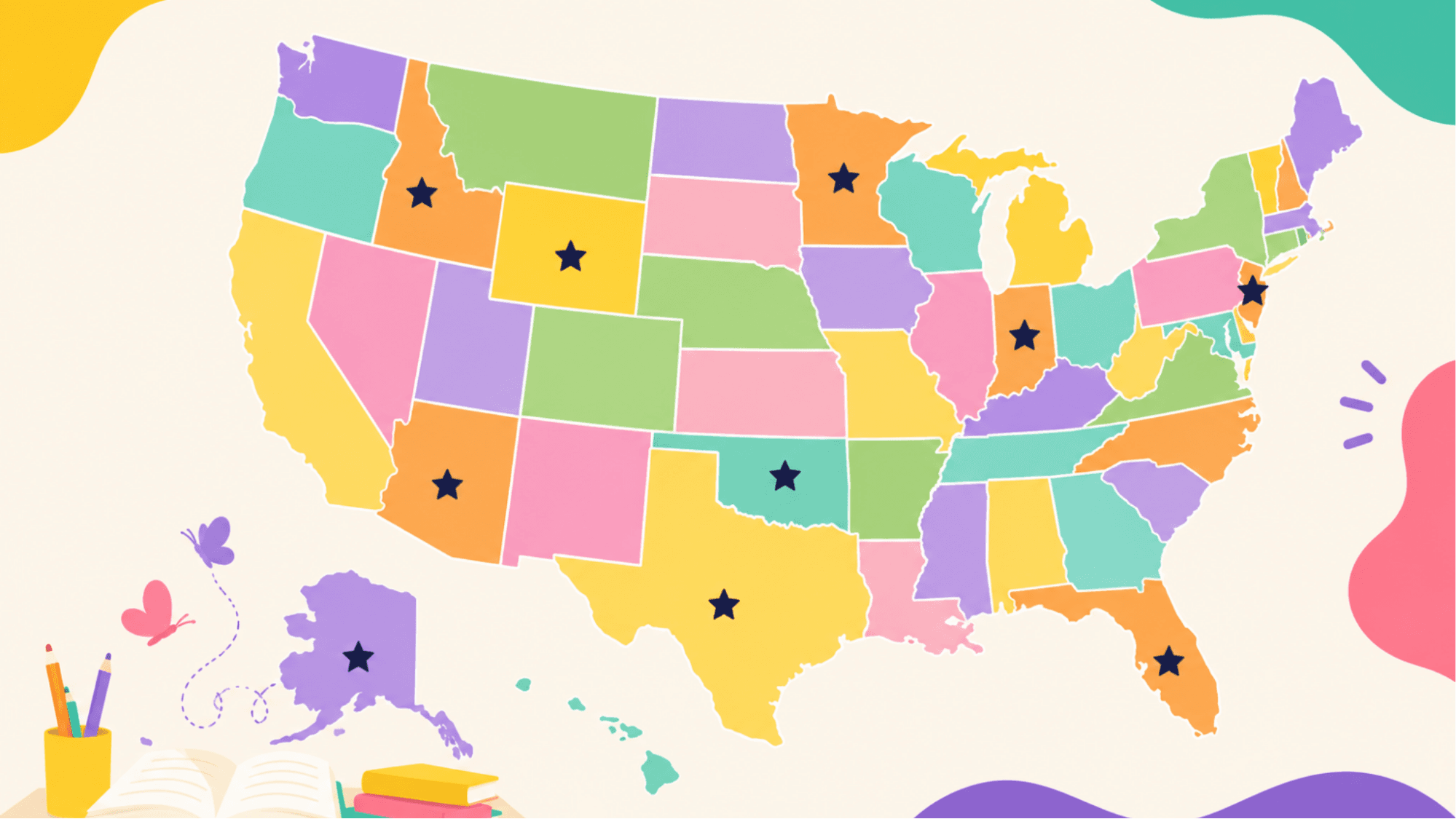

Every homeschooling journey looks a little different, and if you’re in the US, the state you live in can shape how your kiddo learns and grows at home.
Some states offer more flexibility, funding, or access to local homeschool communities. All of these things make it easier to build a routine that fits your child’s learning needs. These differences can influence everything from how you plan your daily lessons to how sustainable homeschooling feels as your child moves through the grades.
So, if you’re considering homeschooling now or in the future, here’s a look at 10 states that many families consider the best homeschool states.
Key takeaways
- The best state for your family depends on flexibility, funding, and available support.
- Homeschool laws vary by state, from minimal oversight to more structured requirements.
- Some states offer financial support like ESAs and tax credits to help offset costs.
- If navigating state requirements feels overwhelming, learn anywhere with bina.
How homeschooling laws differ across the US
Homeschooling is legal in all 50 states in the US, but each state has its own set of homeschool laws that families need to follow.
These differences show up in:
- Parent notification or registration
- Required subjects
- Standardized testing
- Portfolio reviews or evaluations
Differences in homeschool regulation levels
According to the Homeschool Legal Defense Association, states are often grouped into four homeschool regulation levels based on how much oversight and reporting they need from families:
Minimal regulation
States that have minimal regulation don’t require parents to notify a government agency or local school district to get started. Families can usually begin homeschooling with little to no paperwork. However, you should notify your school district if your child is already enrolled in public school and you plan to take them out.
Minimal regulation states include Alaska, Indiana, Missouri, and New Jersey. In general, in these states, parents have more freedom to shape learning around their child’s needs, interests, and pace. They don’t have to keep records or meet state testing requirements.
Low homeschool regulation
States with low regulation, such as Alabama, Arizona, California, and Louisiana, usually require families to submit a simple notice of intent to the local school district or state department of education. There are usually state-mandated subjects, so parents will need to ensure their child is covering the right material, but overall, shifting from traditional school to learning at home is relatively easy.
Moderate homeschool regulation
In moderate-regulation states, families need to do a bit more to start. Along with filing a notice of intent with the school or the state, they may also need to fulfill reporting or assessment requirements, such as standardized testing, professional evaluations, or progress summaries.
Minnesota, New Hampshire, and North Carolina are all states with moderate homeschool regulations. Parents need to plan a bit more carefully to make sure their kiddos are meeting requirements, but they still have plenty of control over how learning looks at home.
High homeschool regulation
High homeschool regulation states, including Massachusetts, New York, and Pennsylvania, have a stricter framework.
Some of these states require state-level curriculum approval, parent-teacher qualifications, home visits, or formal evaluations. While this provides clearer expectations, it can also feel like a lot to manage day-to-day.
For families who feel overwhelmed navigating stricter homeschool regulations, an online school like bina can offer a simpler path. As an internationally accredited virtual school, bina handles all the academic requirements for you.
Your kiddo learns in small, live classes, where learning is guided by a structured curriculum and progress is continuously tracked by certified teachers, so you don’t have to manage assessments, reporting, or compliance on your own.
Try a real class to see how bina supports learning without the added stress.
10 of the most homeschool-friendly states
The best state to homeschool in can mean something different from one family to the next. Some parents may be looking for fewer regulations, while others may care more about homeschool funding, community support, or access to helpful resources.
| State | Regulation level | Funding options | Community support | Standout benefit |
|---|---|---|---|---|
| Arizona | Low | ESA | Strong | High funding ($7-8K/year) |
| Texas | Low | TEFA | Strong | Strong, active community |
| Florida | Moderate | PEP scholarships | Strong | Large ecosystem |
| Alaska | Minimal | Allotments via programs | Moderate | Funding for enrichment |
| Indiana | Minmal | Tax deduction | Strong | Tax benefits |
| Wyoming | Low | ESA | Growing | Outdoor learning opportunities |
| New Jersey | Minimal | Limited | Moderate | Very simple legal requirements |
| Oklahoma | Low | Limited | Strong | Faith-based homeschool network |
| Idaho | Minimal | Limited | Strong | Access to public school programs |
| Minnesota | Moderate | Tax credits | Strong | Testing support |
These 10 homeschool-friendly states each bring something valuable to the table:
-
Arizona
Arizona is one of the most flexible states for homeschooling, with relatively low regulations. A one-time affidavit is enough to officially begin homeschooling, with no ongoing reporting or testing requirements afterward.
Arizona also offers the most established ESA program in the country. Families receive around $7,000–$8,000 per student annually, making alternative learning options financially accessible to more families. ESA funds in Arizona can be used for homeschooling materials, teaching and tutoring services, or for approved alternative schools like bina.
Arizona also has a large and active homeschool community, with statewide organizations like the Arizona Families for Home Education (AFHE) offering resources, practical advice, and a list of homeschool support groups.
-
Texas
Homeschooling in Texas follows a simple, manageable framework. Parents are expected to cover core subjects, but there are no other statewide requirements.
The Texas Home School Coalition (THSC) offers guidance, resources, and a local group finder to help families find nearby homeschool groups and co-ops. Texas also hosts large homeschool conventions, including THSC’s statewide convention, that allow families to explore curricula, hear from experienced homeschoolers, and build community.
Texas will launch Texas Education Freedom Accounts (TEFA) starting in the 2026–27 school year. Under the program, homeschooled students may receive up to $2,000 per year to pay for educational expenses.
-
Florida
Florida is home to one of the largest and fastest-growing homeschool communities in the country. The state’s Home Education Program follows a more structured path than some lower-regulation states: parents file a notice of intent, keep a portfolio, and provide an annual evaluation.
Florida’s established homeschool community, like the Florida Parent-Educators Association (FPEA), makes it much easier for families to find local co-ops and connect with other homeschooling families. Florida also offers scholarship support through the Personalized Education Program (PEP).
Florida Virtual School (FLVS) is another valuable resource for families. Through FLVS Flex, students can access a large catalog of tuition-free online classes taught by certified teachers. This is especially helpful for families who want extra academic support or more course options.
-
Alaska
Alaska offers maximum freedom and minimal oversight when it comes to homeschooling. With very few requirements, homeschooling can feel a lot more sustainable over time.
The state also offers correspondence programs, making it easy for kids to learn at home, as well as funding for curriculum materials, educational supplies, and enrichment activities. This major perk helps cover the cost of extra support or learning experiences that might not fit into the budget, like music lessons or field trips.
Alaska’s IDEA Homeschool Program offers academic advisors, reimbursement support, and access to extracurricular opportunities. Families can get extra help on choosing curricula, tracking progress, or planning ahead as their kiddos grow.
-
Indiana
Parents in Indiana can decide how they teach, but are expected to provide instruction for 180 days per year. Having that clear time requirement can actually be helpful since it gives families a framework for planning the year and building a steady routine.
Homeschooling in Indiana isn’t limited to learning at home. Homeschool students have access to public school resources and courses. They can participate in dual enrollment programs at local public schools or colleges, take high school-level classes, and earn college credit early.
The Indiana Association of Home Educators (IAHE) provides access to local support group directories, legal updates, annual conventions, workshops, and parent mentorship opportunities. Indiana also offers a state tax deduction of up to $1,000 per homeschooled child. Parents may be able to deduct textbooks, workbooks, curriculum materials, and tutoring services.
-
Wyoming
In Wyoming, parents just need to submit a simple curriculum outline and an annual notice of intent to start homeschooling. But one of the best parts about Wyoming is its close proximity to the great outdoors.
The state is filled with state parks, wildlife areas, and public lands, which can be appealing for families who want to incorporate nature-based learning, project-based learning, or experiential learning.
ESA funding is also available in Wyoming. And with support from the Wyoming Homeschool Association, parents can find guidance on compliance, curriculum planning, and information on what to do after graduation or during other transitions.
-
New Jersey
In New Jersey, parents need to provide instruction that is academically equivalent to what is offered in public school. New Jersey is close to major cities like New York City and Philadelphia, which give families easy access to museums, science centers, historical sites, and public libraries.
Real-world learning opportunities can be easily tied into the curriculum. For instance, the Liberty Science Center has constantly updated interactive exhibits that are perfect for science units.
The New Jersey Homeschool Association also helps parents tackle the big question of how to start homeschooling. It provides how-to resources, legal guidance, and referrals to local support networks, making the transition into homeschooling feel much less overwhelming.
-
Oklahoma
For many Christian families, Oklahoma stands out for its strong faith-based homeschooling community. Several organizations across the state help families feel more grounded and aligned as they build a home education rooted in their values.
Homeschool Oklahoma, a Christian homeschool community, offers virtual seminars, e-newsletters, and practical guidance that can be helpful for new homeschoolers. Educators for Christian Homeschoolers of Oklahoma also offers additional support through veteran homeschool parents, real-world professionals, or retired or certified educators.
Aside from its faith-based support network, Oklahoma has low regulations for homeschooling. Parents have to provide instruction in core subjects, but there are few ongoing reporting requirements.
-
Idaho
Idaho is another hands-off state, with no regulations for homeschooling besides instruction for core subjects. Families have real freedom to shape learning around their kiddo’s strengths and interests.
According to Johns Hopkins’ Homeschool Hub, Idaho homeschoolers have the broadest access to public school classes, sports, and extracurricular activities. That means your kiddo can still take part in opportunities like band, robotics, or athletics without giving up the flexibility of homeschooling.
Idaho also has a rich local homeschooling community. For example, Homeschool Idaho brings families together through workshops, graduation ceremonies, and statewide resources. There are also many local support groups that organize meetups, co-ops, field trips, and social events, which can make homeschooling feel a lot less isolating.
-
Minnesota
Minnesota does require annual reporting and standardized testing, but the testing side is easily accessible through the Minnesota Statewide Testing Program.
Parents also receive some financial relief through a tax credit. The state’s K–12 Education Subtraction and K–12 Education Credit can help reduce taxable income and offset certain educational expenses.
Useful resources, workshops, and legal guidance from the Minnesota Homeschoolers’ Alliance (MHA) and Minnesota Association of Christian Home Educators (MÂCHÉ) also help families feel more supported, even in a state with more requirements.
Learn wherever you are with bina
State homeschool laws vary depending on where you live. bina offers a simpler way forward by giving families an accredited, engaging education that isn’t affected by complicated state homeschool requirements.
Small class sizes allow teachers to get to know each child, monitor progress, and adapt lessons in real time. A clear curriculum comes to life through thematic biomes that connect learning to real-world issues based on the UN’s Sustainable Development Goals.
All of this comes together to create a supportive, consistent learning experience that your family can rely on.
For eligible families, bina is also ESA-approved in Arizona and Wyoming, with more states to come. Connect with us to see if bina is the right fit for your kiddo.
FAQs
Which states have the highest homeschool rates?
According to the Johns Hopkins Household Pulse Survey, Alaska has the highest homeschool rate. Tennessee and Montana are close behind.
What are the most difficult states for homeschooling?
New York, Pennsylvania, Massachusetts, and Rhode Island are often seen as more challenging states for homeschooling because they have stricter regulations. Families have to jump through more hoops, including paperwork, evaluations, documentation, and reporting.
What types of funding are available for homeschooling families?
One of the most common funds is an Education Savings Account (ESA). ESAs are state-funded accounts that eligible families can use to pay for approved education-related expenses, including homeschooling costs and tuition for alternative schools.
Some states also offer tax benefits for homeschooling families. Illinois, for instance, offers a K–12 Education Expense Credit, while Alaska has state-funded correspondence programs that give families annual allotments for curriculum, supplies, or enrichment activities.
Accredited, full-time school for grades K-12
Bring the best of the classroom to your home
See if we're a fit

More to read

The 6 best homeschool language arts curriculum options in 2026
Learn the top homeschool language arts curriculum picks for 2026, plus hands-on resources and tips to support reading and writing at home.


10 best online homeschool programs in 2026
Looking for the best online homeschool programs? We compare 10 top-rated options — from fully live schools to self-paced curricula — to help you find the right fit for your child.


The 7 best homeschool reading curriculum options in 2026
Teaching your child to read is one of those core parenting moments you'll remember forever. That feeling you get when they first decode a word or read…
