What should you include in a kindergarten homeschool curriculum?
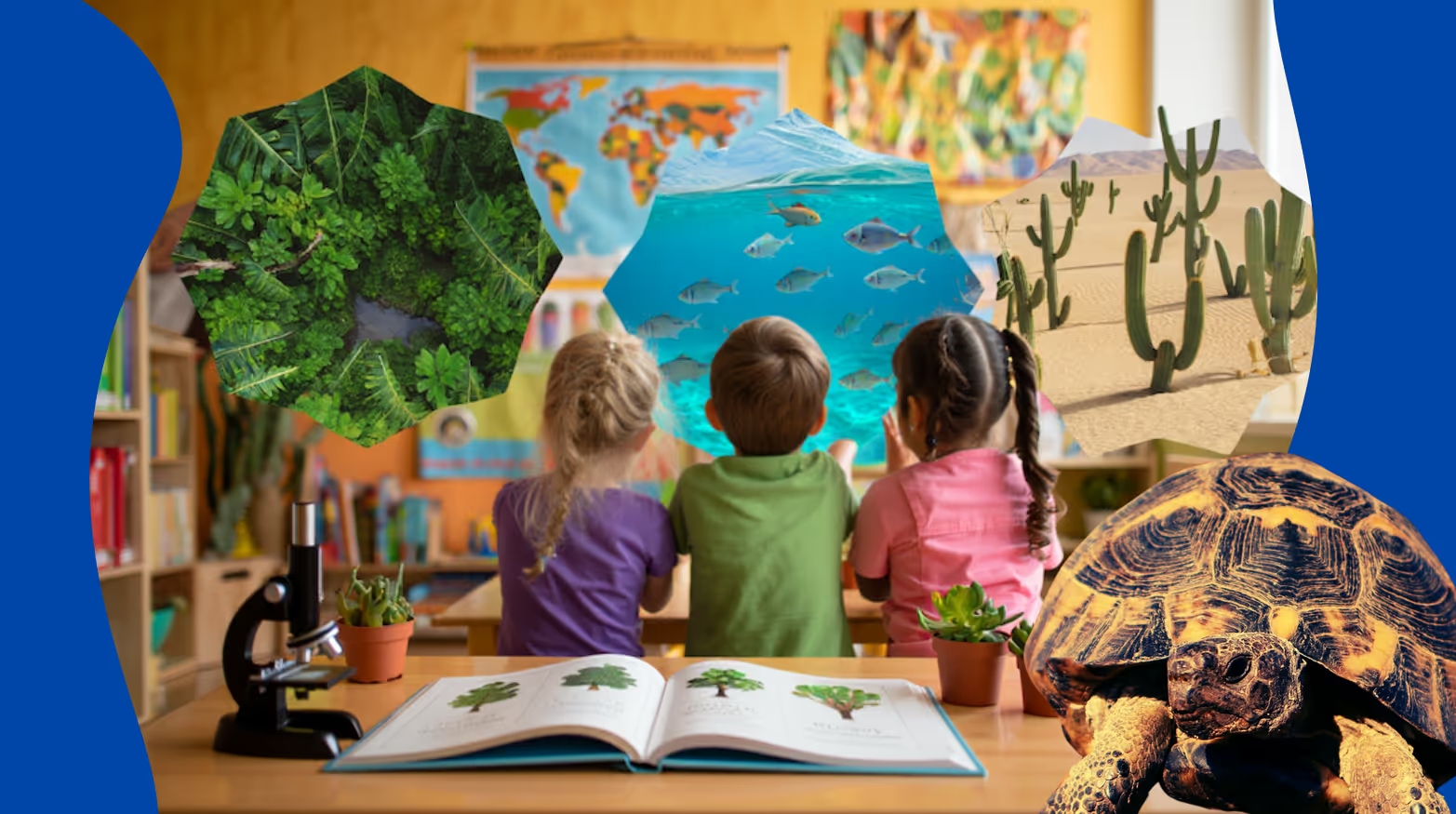
Thinking about homeschooling your kindergartener?
This is a big year for those developing young minds. It’s when kiddos start to learn foundational skills, such as writing simple words, addition basics, and early reading. But a traditional classroom environment isn’t the right choice for every child, especially those who march to the beat of their own drum.
That’s a big reason why some families are opting for a kindergarten homeschool curriculum instead of taking the public school pathway. Each year, around 3.4% of children in the US learn from home. The number of homeschoolers globally is increasing as well. From Australia and South Korea to France, the United Kingdom, and Mexico, more families are starting out their kindergarten-aged kiddos with at-home learning.
But how do you know what curriculum will spark curiosity and help your child learn all those important kindergarten fundamentals?
If you’re considering using a homeschool curriculum for your kindergartener and aren’t sure where to start, this guide is for you. It outlines what subjects to cover, resources you can use, and tips for helping your child have a positive learning experience. Plus, we’ll explain how bina can give you the benefits of at-home learning without you having to put on a teacher’s hat.
What to look for in a kindergarten homeschool curriculum
A kindergarten curriculum is designed for students between the ages of four and six. Whether you intend to homeschool for just one year or are planning on a longer journey, the curriculum should cover everything your child needs to know at this stage.
Besides the basics like reading, writing, math, and art, a good curriculum will include opportunities to develop social-emotional skills like self-awareness and responsible decision-making. This means building resilience, empathy, and relationship skills alongside academic achievements.
What else should you look for? Science experiments and hands-on projects encourage curiosity, while art, music and movement encourage expression and creativity. There should also be plenty of time for play and adventure with games and activities that help your kiddo explore the world, whether through books, local excursions, or virtual field trips.
What to cover in a homeschool curriculum for kindergarteners
So, what should a kindergartener learn?
Here are the important topics to include in a kindergarten homeschool curriculum.
Literacy
Kindergarten is when literacy starts to kick off. Kiddos begin to connect letters with sounds, recognize familiar words, and read simple sentences. Writing their name will be a proud milestone, and they will have fun creating their own stories with pictures and, possibly, a few simple sentences.
A typical homeschooling week of literacy may include reading picture books together, practicing letter sounds (phonics), tracing and writing letters on a whiteboard, and playing rhyming games.
According to the Common Core State Standards, a kindergartener should be able to:
- Recognize and name all letters of the alphabet
- Understand basic letter and sound relationships
- Read common CVC (consonant-vowel-consonant) words such as dog and cat
- Recognize and write their name
When reading with your child, ask them to recall the story to test their comprehension skills. You can also take a field trip to the library and let them choose their books for the week.
Try these literacy homeschool curriculum resources for kindergarten:
-
Reading Eggs**:**An interactive program that uses games, songs, and rewards to help kids learn phonics, sight words, and early reading skills.
-
Teach Your Monster to Read: A playful app where kiddos create their own monster and take them on a reading adventure.
-
Starfall: A free website with stories, songs, and activities focused on letter sounds, simple words, and reading practice.
-
ABC Mouse: Try this free printable resource, which includes the kindergarten sight words.
Mathematics
In kindergarten, learning math means exploring numbers, patterns, and shapes. Throughout the year, your child will work on counting, number recognition, and simple addition and subtraction.
Your homeschooling week may include counting different toys and objects, math games, measuring ingredients while cooking, and shape sorting.
Focus on these key skills from the Core Standards guide:
- Count to 100 by ones and tens
- Write and recognize the numbers from zero to 20
- Understand single-digit addition
- Identify and describe shapes
You can integrate math into daily life, too. Whether it’s counting the leaves you collect from the garden or how many red cars drive past the house, there are always opportunities to learn.
Try these math curriculum resources for kindergarten:
-
ABCmouse**:**Covers a wide range of kindergarten math skills with interactive lessons and games.
-
Khan Academy Kids: A free app with math activities for kiddos between two and eight years old.
-
Bedtime Math: A playful approach to everyday math problems you can do together as part of your daily routine.
-
Coolmath4Kids**:**A website full of math games and puzzles designed to make learning numbers fun.
Art and music
For young ones, the arts should be messy, fun, and creative.
With arts and crafts activities, your child can explore colors and textures and develop those fine motor skills. Songs and music-making using kindergarten-friendly instruments like handbells, castanets, and tambourines help kids express themselves while developing rhythm.
What will your week look like? Think drawing, coloring, cutting, pasting, and threading beads. For music, try playing a tambourine, drum, or maracas along to music from different genres to introduce your child to new sounds. You can also learn songs to sing or create lyrics to music based on how the sounds make you feel.
At this age, the final result can be wonderfully far from perfect — it’s about the adventure more than anything else.
Art also supports social-emotional learning (SEL) skills, including self-expression and confidence.
Try these art and music homeschool curriculum resources for kindergarten:
-
Art For Kids Hub: Step-by-step drawing and craft videos designed for young creators.
-
Deep Space Sparkle: Creative art lessons and project ideas for early learners.
-
The Artful Parent: A blog with simple, playful art activities you can do at home.
-
The Maestro Online: Online music lessons for kids, including one-on-one Zoom lessons for piano, guitar, and drums.
Science
During the kindergarten years, science is all about discovery. Kiddos learn from observing, experimenting, and asking questions.
Whether it’s collecting rocks or charting the weather, at-home science doesn’t have to be complicated. Your homeschooling week may include making slime, planting an indoor garden, and watching educational videos. You can also take advantage of tech with interactive apps and science-themed games.
The Next Generation Science Standards (NGSS) outlines key areas for kindergarten-aged children, and suggests you help your child:
- Explore pushing and pulling movements
- Learn about plants and animals
- Discuss weather and seasons
- Try simple, hands-on experiments
Remember to encourage your child to ask questions, make predictions, and discuss the outcomes.
Try these science curriculum resources for kindergarten:
- Mystery Science: Video lessons that combine storytelling with hands-on activities.
- The Good and the Beautiful Science Units: Science units with simple experiments and colorful visuals.
- Science Buddies: A free site with easy experiments and activity ideas for young learners.
- National Geographic Kids: Videos, facts, and science-themed games for curious kiddos.
Play
For children, play is essential. It’s how they build social skills, try new things, and express themselves. Playtime isn’t just a break from learning — it is learning.
A typical homeschooling week might include dress-up games, building forts, virtual playdates, trips to the park, and imaginative adventures with toys. Play also gives your child a chance to practice important life skills like problem-solving, empathy, and communication.
The Collaborative for Academic, Social, and Emotional Learning (CASEL) identifies five core SEL areas that can be nurtured through play. Here are some examples we’ve put together using the CASEL framework as a guide:
- Build relationships through cooperative games (can be virtual)
- Practice self-control during turn-taking and group play with family members
- Use your imagination to express thoughts and emotions with drawing or painting
- Practice problem-solving with puzzles, scavenger hunts, and building with magnets
Try these play-based learning resources for kindergarten:
- Busy Toddler: A blog with play activities for different age levels, using items you already have at home.
- Generation Mindful: A program that uses games, routines, and tools to build SEL skills.
- The Imagination Tree: Creative play ideas focused on sensory play, role-play, and storytelling.
- Toolbox Project: A set of 12 tools — kiddos can learn through stories, visuals, and play.
Remember, you can merge some of these subjects. For example, if your child collects rocks, they can identify them for science, count them for math, and then paint them for art.
Should you include SEL in your kindergarten homeschool curriculum?
Yes, social-emotional learning can support our littlest learners. It doesn’t have to be a separate lesson; it can be tied into other subjects such as art or literacy. For example, here is a list of books with an SEL focus that you can read with your child.
Kiddos are still learning how to manage emotions, build relationships, and understand themselves and others at this age. SEL helps their mental health and their confidence.
At bina, SEL is part of the daily routine. Students start each day with a check-in and a calming activity such as mindful breathing. Teachers help children set goals, solve problems, and build positive relationships — all while meeting academic milestones in a fun and engaging way using biome-themed units.
How long should children spend at kindergarten homeschool each day?
For kindergarten-aged kiddos, two to four hours of structured learning each day is usually enough. However, you’ll still need to set aside additional time for games, downtime, and free play.
For many parents, this kind of hands-on involvement can be difficult to manage, especially without a teaching degree.
But there’s bina if you’re looking for an at-home school for your kiddo. We are a live, online school for children aged 4 to 15, offering live learning with experienced teachers and small class sizes. So your child stays engaged and has fun, and you don’t have to take on the role of a full-time educator.
Five tips for kindergarten homeschooling
Want to make homeschooling work for your family? Try these tips:
1. Keep lessons short and interesting
Kiddos this age need lots of breaks, so don’t try to force them to sit down and study if they aren’t in the mood. Keep lessons short, and be prepared to mix it up if you need to. For example, you can always enhance a math lesson with some painting by numbers or building with blocks. You can turn science into something spectacular with song and dance. And literacy is always a blast when you get to act out what the characters are doing or make up a new ending.
2. Follow your child’s interests
Children will be more likely to absorb information if they are engaged with the content. To make it relevant, add touches of their personality into the curriculum.
For example, if they love dinosaurs, use this as a reference when learning about size and comparing objects. If rainbows make them smile, teach them how to create patterns using colors.
3. Don’t feel like you need to do it all yourself
Homeschooling is a full-time commitment, so you might find that you need some support to make it work for your family. Try to find other parents to connect and share ideas with, and make sure to take time for yourself to unwind.
Children also benefit from socializing with other kids. Whether it’s virtual playdates or after-school activities such as dance or soccer, it can be a nice way to break up the day.
You can also opt for an online school that teaches kindergarten-aged children. bina gives you all the perks that come from being at home, but with a live teacher and classmates.
4. Create a dedicated space
Your child should have a dedicated space for learning. It can be part of the living room, a space in their bedroom, or somewhere else. Consider setting up a desk with all the tools your child needs. The basics will include a laptop, headphones, pencils and crayons, paper, and materials for basic arts and crafts, like glue, construction paper, and kid-friendly scissors.
Let them decorate and personalize their space so they love going to their ‘school’ in the house.
5. Set a routine
A regular routine can help your child feel secure and stay on track. Just like a bricks-and-mortar school day, try to follow the same routine each day. For example, a kindergarten homeschool day might look like this:
- Start with a short game or mindfulness activity in the morning.
- Spend half an hour to 40 minutes on math activities before a healthy snack.
- Dive into a science video lesson and an experiment before lunch.
- The afternoon might include practicing reading, working on a story, or acting out a play.
- After literacy learning, there’s time for arts and crafts, songs, and dancing.
Make sure you have everything ready before the day begins. From a charged laptop to the daily planner, your child should be able to jump straight in.
Kindergarten at bina
If you want your four to six-year-old to start school at home but aren’t sure about managing a homeschool curriculum yourself, bina is another option.
At bina, kindergarteners are in small classes (up to six kids for this age group) with students from around the globe. Our curriculum is grounded in UK standards and the US Common Core, and it also incorporates aspects of the International Baccalaureate (IB PYP) and the Australian curriculum. We use biomes to make learning engaging and keep you in the loop with ongoing communication.
Book a call and find out if bina might be the right fit for your kiddo!
Accredited, full-time school for grades K-12
Bring the best of the classroom to your home
See if we're a fit

More to read

How to Create an Awesome 2nd-grade Homeschool Schedule
Discover what a 2nd-grade homeschool schedule should include. Get tips, schedule examples, and strategies to keep your child engaged.

Want to homeschool in Canada? A simple guide for families
Discover the rules you need to know to homeschool in Canada, along with a guide to get started, curriculum options, and extra resources.
Homeschool music curriculum: Choices, resources, and challenges
Discover the best homeschool music curriculum options, extra resources to aid learning, common challenges, and how bina can help.