What to do when your kiddo is bored in class (and what it could mean)
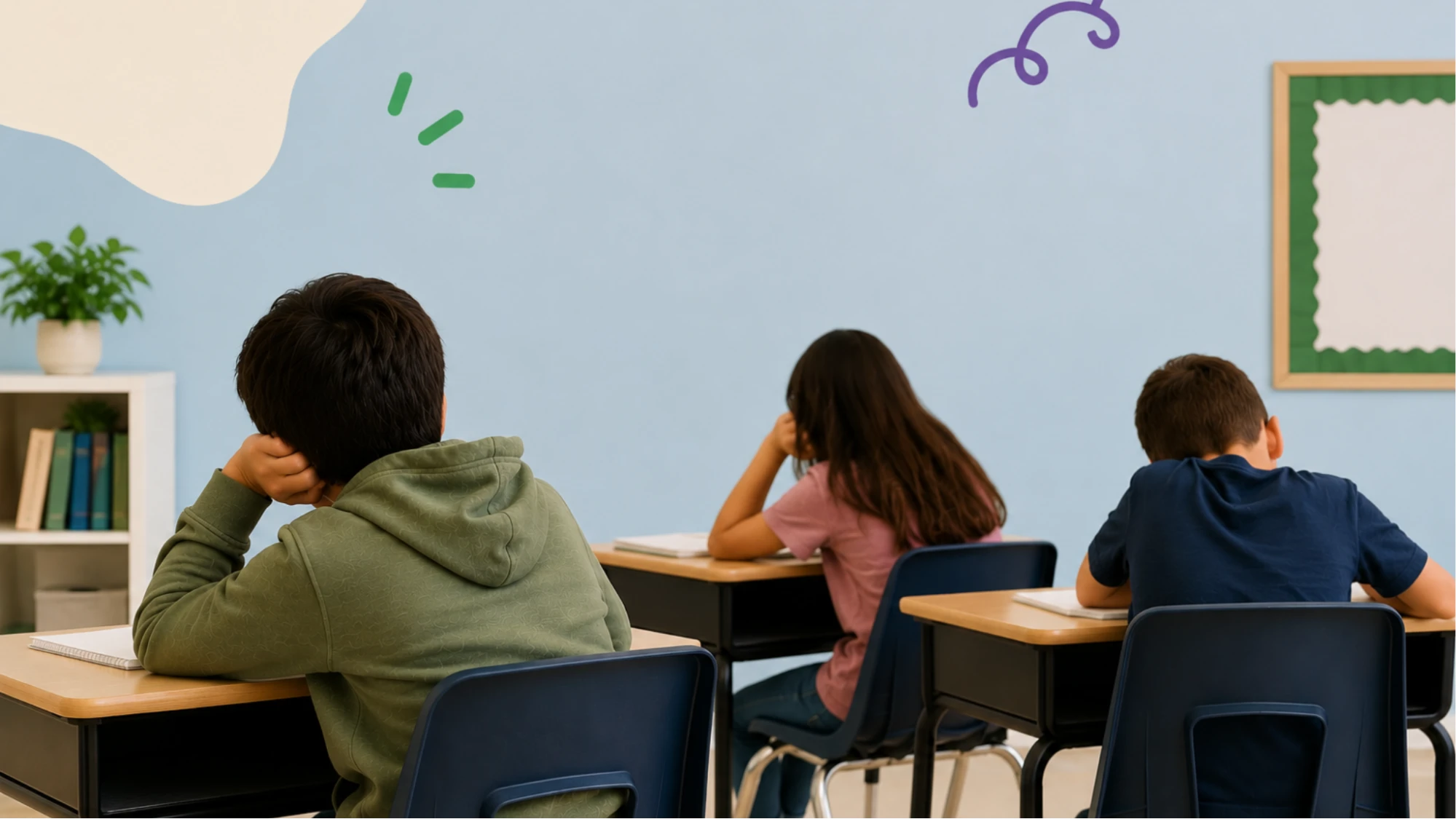
When a child consistently says they’re bored at school, they’re usually telling you that something about the learning isn’t a match. The pacing could be off, the format may not suit how they think, the work is too easy or too hard, or no one in the room has noticed what they need. Boredom is information, not a character flaw.
Maybe you’ve brushed it off, or you’ve told them that school isn’t always supposed to be exciting anyway. Boredom in the classroom is incredibly common, and it’s rarely a sign that your child doesn’t care about learning. It could be an issue with the teacher or the school.
But how do you find out whether this is the case? Let’s unpack what this information might mean and what you can do if your kid is bored in class.
Key takeaways
- Feeling bored at school usually means the pace, format, or level of challenge isn’t a good fit.
- You can find the cause by asking your kiddo questions and talking to their teacher.
- Project-based and interdisciplinary learning engages kids by showing them why subjects matter in real life.
“I’m bored” is a symptom: Here’s what your kid may be telling you
When your kiddo says, “I’m bored,” they’re describing a mismatch between them and their learning environment.
Depending on your kiddo, “I’m bored” might mean:
- I’m not being challenged: the material feels too easy or repetitive, and there’s no reason to stay mentally present.
- I’m overwhelmed: the work is actually too hard.
- I don’t see the point: nobody has explained why this matters or how it’s connected to anything they care about.
- Nobody’s asking me what I think: they’re listening and filling in the blanks, but nobody has invited them to truly participate.
- I don’t feel safe enough to engage: they may feel invisible in a large class or anxious about getting something wrong.
If you’re wondering whether there’s real research behind this, there is. Pekrun’s Control-Value Theory of Achievement Emotions holds that classroom boredom tracks two things. The first is how much control a child feels over their learning. The second is how much value they see in the task in front of them. Take either away, and boredom follows.
Additional research also shows that boredom isn’t just a motivational issue. It functions as a form of stress that can interfere with a student’s ability to focus.
For instance, a kid who finds material too difficult often reports feeling bored, not frustrated. In that case, the overwhelmed working memory has trouble engaging, similar to what happens when the mind is stressed.
Students dealing with emotional stress (including anxiety or trouble at home) also report higher boredom. This isn’t because the lesson is boring, but because their attention is already spent. What’s more, Harvard’s Todd Rose says, “We need to get away from thinking that the opposite of ‘bored’ is ‘entertained.’ It's ‘engaged.’”
So, when your kid says, “I’m bored at school,” consider that feedback, not a complaint. They’re telling you something about the fit between them and their learning environment.
Why traditional classrooms breed boredom
A Gallup Student Poll from 2012 surveyed nearly 500,000 students in grades 5 to 12. In this survey, they found that nearly 8 in 10 elementary students were engaged with school, but by middle school, that number dropped to 6 in 10. By high school, it drops to 4 out of 10.
A 2024 study from the Walton Family Foundation and Gallup found that between 25% and 54% of middle and high school students say they’re not having engaging experiences in school. Fewer than 2 in 10 strongly agree that what they’re learning feels important, interesting, or aligned with their natural talents.
Another Gallup study from 2025 found that while 76% of students say they participate in class activities, fewer than half say they enjoyed their classes. Roughly one-third report being “always” bored. This shows that participation alone doesn’t equal engagement.
The above studies show a pattern that points to how classrooms are designed and how that design is failing today’s generation. Here’s what kids are facing today:
Large class sizes where kids disappear
Children in larger primary classes are more likely to engage in passive behavior, such as listening to the teacher instead of interacting. It’s only in smaller classes that kids are consistently active and engaged. Schools with smaller class sizes can mitigate this challenge.
One-size-fits-all instruction
Harvard’s Jal Mehta calls it the switch from “child-centered learning to subject-centered learning,” where the curriculum drives everything, and the child has to keep up or fall behind. This is problematic for kiddos who need extra support and for gifted students who need to be challenged more.
A school in which teachers know where each child actually is and can adjust in the moment allows some students to pull ahead while others can get a second pass at the same concept. That only works when class sizes are small enough and led by expert educators.
Passive lecture-and-worksheet formats
When students have little autonomy or choice in how and what they learn, boredom increases and motivation drops. Again, this can be true for both kids who require additional support and for a gifted child. On the other hand, when teachers encourage autonomy, boredom drops.
Content disconnected from real life
When your kiddo can’t see why something matters, they may stop caring, and no amount of repetition fixes that.
No emotional infrastructure
A lot of traditional classrooms don’t have structured time for students to process emotions, build relationships, or feel seen, so kids who are struggling emotionally simply disengage.
Most educators are doing incredible work with limited time, oversized classes, and rigid curricula they didn’t choose, so this isn’t their fault. The point is that boredom often isn’t a kid problem. It’s a design problem, and recognizing that changes everything about how you can respond as a parent.
The real cost of letting classroom boredom go unchecked
Occasional boredom is normal, and it’s even beneficial for kids to feel bored from time to time as it gives them the chance to daydream and use their imagination. But when it becomes chronic, the consequences can run deep.
Reduced motivation
A meta-analysis published in Educational Psychology Review found a significant negative relationship between boredom and academic outcomes like achievement and motivation. Without engagement, intrinsic curiosity fades, and learning becomes something to survive instead of enjoying.
Increased burnout
A 2023 study published in Frontiers in Psychology found that students who experience academic boredom have diminished life satisfaction and higher levels of burnout. Very bored learners typically avoid schoolwork, reduce their efforts, and show weaker self-regulation.
Behavioral issues
Research published in the journal Medical Teacher shows that boredom often coincides with attention problems, and it has a negative impact on intrinsic motivation, effort, and self-regulation.
What looks like acting out, zoning out, or “not trying hard enough” is often disengagement in disguise. Additional research shows that boredom disrupts the brain’s prefrontal cortex and allows the emotional center to take over, which can lead to anxiety, restlessness, or shutting down.
A kid who’s bored for long enough can also start to believe they’re just “not a school person.” This stigma can follow kids for years and can even contribute to higher dropout rates: 50% of high school dropouts cite boring, irrelevant classes as their primary reason for leaving.
What engaged learning actually looks like
If boredom during class time is a signal, what does a signal for engaged learning look like in practice? Here are the conditions that the research consistently points to. If your child’s current classroom doesn’t reflect most of them, the boredom they’re expressing may have less to do with them and more to do with the environment.
These conditions are already a part of schools designed around how kids actually learn, including alternative and online schools that have rethought the traditional model from the ground up.
Small groups where every kid has a voice
When class sizes are small, teachers can observe each child closely, offer timely and specific feedback, and build real relationships. Students are far less likely to feel invisible, which is one of the fastest paths to boredom.
Projects rooted in real-world problems
A meta-analysis in Frontiers in Psychology found that project-based learning (PBL) has a significant positive impact on student learning outcomes. This includes academic achievement, motivation, and higher-order thinking skills.
Plus, a UCLA literature review adds that PBL enhances collaborative behavior, intrinsic motivation, curiosity, and aspects of social-emotional learning across grade levels. All of these can help prevent chronic boredom.
Teachers who adapt in real time
If a teacher doesn’t track and adapt to individual needs, kiddos can fall behind or start losing interest because the material is too repetitive for them.
In engaged classrooms, teachers read the room, adjust pacing, and meet each kiddo where they are.
This is a concept that bina calls precision education, and it addresses the causes of chronic boredom at the root. Not every school has the resources to provide precision education. While that’s not the teacher’s fault, it’s an important consideration when choosing a school for your kiddo.
Learning that blends subjects through themes instead of siloing them
When a kiddo explores, for example, an ocean biome and weaves together science, literacy, math, and social-emotional skills around a single theme, learning can feel connected and meaningful. And since understanding why something matters is important to promote engagement and reduce boredom, this holistic approach can make a huge difference.
Social-emotional learning (SEL) woven into the day
A meta-analysis of school-based universal interventions found that students who participate in SEL programs demonstrated significantly improved skills, attitudes, behavior, and academic performance. However, SEL learning doesn’t happen on its own. Classrooms that make it an active part of the curriculum help their kiddos develop the emotional intelligence they’ll need to lead fulfilling lives, but also remain engaged throughout their academic years.
What to do when your kid keeps saying, “School is boring”
We’ve covered why boredom happens and how it can impact your child. Now, here are some actionable tips for what to do when your kiddo is constantly bored in class.
1. Start with curiosity, not correction
Instead of saying “Why are you bored?” try asking your kiddo, “What could make it better?” or “When was the last time you were really into something you were learning?” These questions shift the conversation from blame to discovery.
Your kiddo’s answer will also tell you a lot about what kind of learner they are and what conditions will help them thrive.
2. Talk to the teacher
In some cases, the boredom issue can be settled with a simple conversation. Approach your child’s teacher with the right questions to make this conversation productive.
Instead of “My child says they’re bored,” try asking, “What does engagement look like in your classroom?” and “Does my child seem to participate or withdraw?” This opens a collaborative conversation without placing the blame on the teacher.
3. Look for patterns
Is your kiddo’s boredom related to a specific subject, or does it show up all the time? Is it worse on certain days, in certain formats, or during certain times of the year?
Patterns help you distinguish between occasional boredom, which is normal, and chronic disengagement, which is worth further investigation.
4. Check for hidden stressors
Boredom can be a mask for anxiety, social difficulties, or feeling overwhelmed. If your kiddo seems emotionally flat or resistant to school in general, the root cause may not be academic at all.
5. Evaluate the environment honestly
If all else fails, it’s time to not only evaluate your child’s learning environment but also to know when to look for a different school.
Is the classroom set up to support your child specifically? Does the class size allow them to get the type of support they need to succeed? Is there any social-emotional support woven into the school day?
Considering alternative schooling doesn’t mean you’re giving up or blaming traditional school, but it does mean recognizing that some kids thrive in environments that are built differently.
Find the right fit for your kiddo to stay engaged and thrive at school
Sometimes, the fix to boredom is a simple conversation with your kiddo or their teacher. Sometimes, it’s a shift in the approach at home. But it also might mean exploring a school built differently—one where your child is known, challenged, and genuinely engaged every day.
That’s the school we set out to build. In a bina classroom, your child is one of no more than 12, so their teacher notices the day they check out and acts on this signal before it becomes a pattern. Lessons move at your kiddo’s pace. And because learning is built around real projects and real places, the question of “why does this matter” tends to answer itself.
We also treat feeling known as part of the academic work, with social-emotional learning directly built in. A child who feels safe and seen has attention to spare for learning.
If that sounds like what your family needs, start your bina journey to see if we’re the right fit.
Accredited, full-time school for grades K-12
Bring the best of the classroom to your home
See if we're a fit

More to read

Structured learning for kids: The ultimate guide to your options
Learn what structured learning means, when and how it benefits your kiddo, and what a structured learning setup can feel like.

Why elementary schools with small class sizes matter
Discover why small class sizes matter in elementary school, what “small” really means, and how to find a close-knit learning environment for your kiddo.
Why an ADHD online school may be a good fit for your kiddo
Learn how an ADHD online school may support focus, flexibility, and individualized learning, and find out how you can help your kiddo thrive.