Learning styles for kids: A practical guide for parents
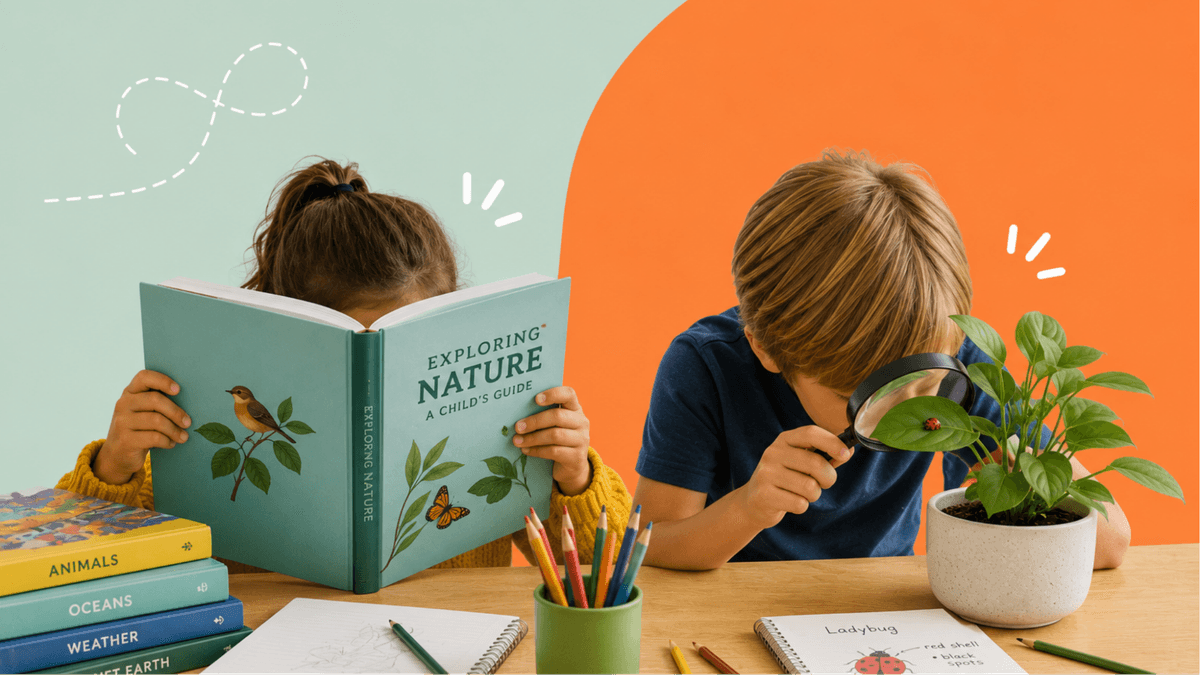

Learning styles describe the way kids most naturally absorb new information. They’re useful tools for understanding why some subjects just click, and others take more time.
As a parent, being able to identify your children's learning styles gives you insight into where their motivation and curiosity lie. Do they light up when they sing the clever song about the order of the planets? Do their eyes sparkle when they dive into their new book on volcanoes?
In this article, we explore the different learning styles for kids, break down the concept of multimodal learning, and give you tools for instilling a lifelong love of learning in your child.
Key takeaways
- The most common learning styles for kids include visual, auditory, reading/writing, kinesthetic, social, solitary, holistic, and analytical learning.
- Understanding a child’s preferred learning style can be a helpful tool for motivation and engagement, but it shouldn’t be used to place children in a box.
- Embracing multimodal learning (using multiple styles at once) teaches children resiliency and adaptability.
- A project-based approach allows children with different learning styles to stay passionate about learning and explore topics in more meaningful ways. At bina, we use projects tied to the real-world through our biome-themed units to help kiddos learn more deeply.
What are learning styles for kids?
Learning styles describe the different ways kids naturally interact with new knowledge. There are many kinds, but the most common categories you’ll hear about come from the VAK/VARK model created by Neil Fleming, an educator from New Zealand.
He proposed the following four styles:
- Visual learners love visual aids like charts, mind maps, and educational videos. For them, seeing is understanding.
- Auditory learners rely on hearing and speaking to consolidate new concepts, and they love verbal directions.
- Reading/Writing learners use a word-based type of learning, where understanding is built from narratives and the written word.
- Kinesthetic learners love movement, tactile feelings, and hands-on experiences. They’re very receptive to body language and facial expressions.
Other common learning styles educational psychologists and researchers have named include social, solitary, holistic, and analytical learning styles.
- Social learners prefer a collaborative learning process and thrive in group projects and group discussions.
- Solitary learners prefer self-paced research and independent thinking. They enjoy receiving personalized feedback from their teachers.
- Holistic learners need to see the big picture before the details make sense or seem relevant.
- Analytical learners rely on logic and detailed steps or formulas to make sense of new ideas.
Learning styles were popularized in the 1970s, until being disproved in a report from Psychological Science in the Public Interest, a journal of the Association for Psychological Science. Researchers have found that people don’t just learn best using one style. As Howard Gardner, a psychologist, explained in his book, Frames of Mind, someone’s overall intelligence is a collection of different types of cognitive abilities, or learning styles, which he calls the Theory of Multiple Intelligences.
What we know today is that we all have learning preferences: our favorite ways to learn. But these preferences aren’t static. And they shouldn’t be used to categorize learners. Nor should educators and parents shield kids from exploring different subjects using multiple learning styles, as that’s what will help young minds grow while building resilience, cognitive skills, and confidence.
What’s my child’s learning style?
Having a basic understanding of different learning styles and preferences gives kids the chance to analyze their unique learning process and work through challenges with curiosity, rather than self-criticism.
If a child can learn to use different learning styles at a young age, they’re better able to explore, challenge themselves, and grow. Also, identifying your child’s learning preferences can help you inspire them in moments of doubt or demotivation.
How to identify learning styles in the moment
- Visual learning style: Visual kids have a better chance of completing their chores when they have a chart to track their progress. Your kiddo might struggle to grasp a concept until they see a diagram showing the order of events or the relationship between objects. An example of this would be using a drawing of the human body to explain where your organs sit and how food travels through them during digestion.
- Auditory learning style: You’ll watch the light switch on in your child’s eyes as they talk you through what they learned today and identify the patterns in real-time. These kids will typically remember the story their teacher read them in great detail.
- Reading/writing learning style: Your kiddo remembers how to spell complicated words by physically writing the word a few times. They might forget verbal instructions, but if you write down a list of steps, they can absorb and retain the information more easily.
- Kinesthetic learning style: For these kids, fractions start to make sense when they can split the felt pizza into increasingly less generous slices. You might spot them tapping their fingers on the table as they recall points in a list. They might be able to spell more complicated words when they draw the letters with their fingers as they go.
- Social learning style: These kids are social butterflies, drawn to crowds and conversation. They tend to enjoy debating concepts or analyzing them among peers.
- Solitary learning style: A solitary child may need time to think a new concept through on their own before they truly understand it. They might find group work and discussions overwhelming or frustrating.
Keep in mind that most people have many different learning styles that they’ll use depending on the subject, their energy levels, or the environment they’re working in. By watching your child behave and learn in different situations, you’ll start to build a well-rounded understanding of which processes they prefer to use.
What does a learning preference mean in the long run?
Learning styles aren’t supposed to be limiting. Preferences can change over time or depend entirely on the situation you’re in.
It’s important to teach kids that they won’t always be able to learn in their preferred manner. You can’t become good at driving a car if you only read about what to do. You need hands-on practice turning the wheel and experiencing a variety of on-the-road scenarios to learn. In the same way, kids can’t pick up a new language without hearing the sounds and speaking the words themselves, nor can they learn how to bake a cake well without mixing the ingredients and tasting the results.
Exploring different learning styles works in the same way. By switching gears, going from discussing a lesson in class, to sitting quietly and writing out an idea, to gathering with other classmates to collaborate on a project, kids develop how to thrive within a variety of learning modes.
And, by being adaptable, kids can tackle topics that would otherwise be difficult to learn with just one style. This leads us to multimodal learning — an approach that relies on several different styles at the same time.
How to help your kid embrace multimodal learning
Just as combining multiple subjects improves memory retention, combining multiple types of learning improves a child’s ability to learn. The more ways you look at a concept, the more deeply you can understand it.
Stay flexible
Don’t get caught up in classifications and groups. Children, especially when they’re young, may interpret learning style categories as limiting factors and start to believe that they can’t learn any other way.
Let your child explore topics in whatever way comes naturally to them, even if that changes day to day. If they seem stuck, encourage them to tackle the problem from a new angle and help them brainstorm or research new methods to try.
Embrace a growth mindset
The next step is to help your child move through the process of learning. Help them see the magic of discovery, the satisfaction that comes with hard work, and the opportunity for growth that lies in every “failure.”
By teaching children to enjoy the journey, parents and educators set them up for a future that feels exciting, not intimidating.
Know when to ask for help
If your child does seem to be struggling in an area, here are three practical tips for working with your kiddo’s educator:
- Stay involved with your child’s learning so you can quickly see when something is “off.” The better you know your kiddo, the better equipped you are to recognize when they need help.
- Speak up if you notice a problem. As educators, we want to prevent gaps in understanding from growing out of control. Ask your child’s teacher if there are any activities or resources your kiddo would benefit from.
- Don’t panic if something takes longer than usual to sink in. Kids need to learn how to work through feelings of frustration. Challenges build resiliency, which is a skill they’ll use for the rest of their lives.
Use social-emotional learning
Social-emotional learning involves all the skills needed for emotional regulation and self-awareness. It gives kids the tools to navigate challenges and failures with grace for themselves.
It also plays a huge role in building and maintaining healthy relationships among peers. With strong social-emotional skills, kids feel safe sharing their learning process and learning from one another.
How bina incorporates multiple learning styles for kids
Here at bina, we use a project-based learning approach that gives learners questions they answer through self-led exploration. They work on projects that teach real-world skills, like baking or budgeting, through immersive learning.
This project-based approach leans into several learning styles at once. As they explore answers to their questions, kids get to practice blending styles together. They might start a project with reading and research, and then design a project using kinesthetic and visual learning skills. They have control over how they let their curiosity wander in search of an answer, which helps them practice agency.
Projects that span subjects, mediums, and learning styles
In one project, we had our learners explore the Arctic tundra through their research. They used different forms of media to research, such as books describing the climate and vlogs showing what life was like.
Their final project involved creating a multimedia presentation that provided a glimpse into the lives of people and animals who existed in these environments. They created 3D models of the specialized homes locals built to stay warm, and created recipes using local ingredients. Finally, the learners composed soundtracks inspired by life in the tundra.
Through this experience, learners of all preferences felt engaged and motivated, helping the kiddos feel truly immersed in what they were learning.
Discovering how to learn with your child
At the end of the day, learning styles are tools that parents and educators can use to encourage a child’s natural curiosity. Allowing them to create their own methods for research and work their way through challenges builds important skills that kids can take with them throughout their lives.
At bina, we love seeing how different kiddos approach the same topic in a completely unique way. Our goal is to give our learners the tools they need to follow their curiosity and take the lead with their education. Connect with us today to learn more about our global online school and how we’re teaching the next generation with an internationally accredited, immersive curriculum that prepares kiddos for a brilliant future.
Accredited, full-time school for grades K-12
Bring the best of the classroom to your home
See if we're a fit

More to read

How using all 8 learning styles keeps kids engaged
Learn how bina teachers use the 8 learning styles to keep your kiddos curious and engaged throughout the virtual school day.


Summer homeschool curriculum ideas without school-at-home
Summer often gives parents a clearer picture of how their child actually likes to learn. Some children suddenly read for fun again. Others become more…


My child hates school: What it means, and what to do next
Learn why your child hates school and how to overcome school distress, including practical steps and alternative learning options that actually work.